 |
 |
 |
http://www.varalaaru.com A Monthly Web Magazine for South Asian History [189 Issues] [1849 Articles] |
|
|
|
http://www.varalaaru.com A Monthly Web Magazine for South Asian History [189 Issues] [1849 Articles] |
|
Issue No. 188
இதழ் 188 [ ஏப்ரல் 2026 ] 
இந்த இதழில்.. In this Issue..
|


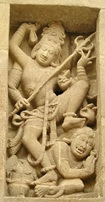
Ravana, who held the title of king of Lanka, was a devout follower of Lord Shiva. When his chariot brought him into the vicinity of Mount Kailasa, he, at that point, made an effort to try and remove it from the ground and raise it. The goddess Parvati, finding herself in close proximity to Lord Shiva, was seized by a sudden feeling of fear. Reacting to the circumstances, Lord Shiva then applied pressure to the mountain by placing the tip of his toe upon it and pushing it down. Consequently, the formidable Ravana found himself entombed under the colossal Mount Kailasa, enduring agony beyond measure. Ravana experienced a sense of regret once he recognized his error. Driven by profound devotion, he extracted the nerves from his hand, meticulously crafting them into strings for a veena, an instrument upon which he then commenced playing and singing hymns in adoration of Lord Shiva. With Ravana's demonstration of profound devotion and musical talent earning his favor, the Lord was pleased to bestow his grace upon him. Ravana Anugraha Murty is the appellation given to this specific form of Shiva, characterized by the act of Shiva bestowing his grace and blessings upon Ravana. 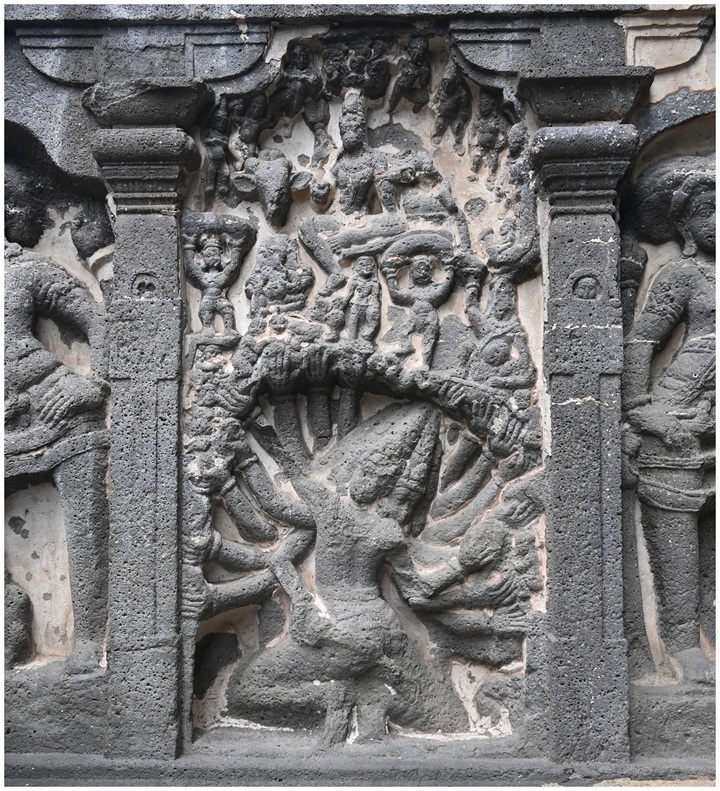 Looking at the picture presented above served as a potent reminder for me of a poem that was penned by the celebrated Tamil Sanga Pulavar, Kapilar, as part of his collection known as Kurunji Pattu. இமையவில் வாங்கிய ஈர்ஞ்சடை யந்தணன் உமை யமர்ந் துயர் மலை இருந்தனனாக ஐயிரு தலையின் அரக்கர் கோமான் தொடிப்பொலி தடக்கையிற் கீழ்புகுத் தம்மலை எடுக்கல் செல்லாது உழப்பவன் போல. Imaiya vil–vaaṅgiya… | eer-nchadai andhaṇan… Umai amarndhu… | uyar malai irundhanan aaga… Ayyiru thalaiyin… | arakkar kōman… Thodippoli thadakkaiyin… | keezh puguthu… Am-malai… | edukkal sellaadhu… Uzhaappavan… | uzhaappavan pōla… The ascetic Lord of flowing matted locks, who once bent mighty Meru as His bow, sat upon the lofty mountain with Uma beside Him in serene grace. Then the demon king of ten fierce heads, his great arms adorned with resounding bangles, thrust them beneath that mountain— striving to lift it. Yet he could not move it; he struggled and struggled in vain, like one condemned to endless toil. According to Kapilar's narrative, Lord Shiva, distinguished by his use of Mount Meru as a bow and the presence of the Ganges in his hair, was seated alongside Uma upon a towering mountain. Ravana, the formidable ten-headed monarch of demons, whose powerful, elaborately adorned arms were further embellished with resplendent bangles, made a determined effort to heave the substantial mountain by placing his hands beneath its base, only to struggle ineffectively and fail in his endeavor to elevate it. Concept and Meaning In the iconography of Ravana anugraha-murty, we observe a compassionate manifestation of Shiva, who bestows his divine favor, referred to as anugraha, upon the demon king Ravana subsequent to overcoming the latter's excessive pride. The icon encapsulates a profound theological concept, illustrating how divine compassion is capable of surpassing individual ego and, in doing so, can bring about a transformation even in a follower who possesses flaws. This powerful theological notion, conveyed by the icon, suggests that divine mercy operates beyond the confines of personal self-importance and possesses the capacity to alter even those believers who are imperfect. Through its imagery, the icon effectively communicates the significant theological principle that divine kindness exists independently of the ego and has the ability to reshape even a worshiper who is not without fault. Mythological Core The storyline, which draws its origins from both the Shiva Purana and the Ramayana, specifically its Uttara Kanda section, develops in the following manner. • In his arrogance fueled by immense power, Ravana made a bold and ultimately futile attempt to dislodge and lift the formidable Mount Kailash from its foundational position. • With a mere press of his toe, Shiva effortlessly subdued him by pushing down the mountain. • Having been entombed for a millennium, the demon king Ravana undergoes a profound transformation, channeling his immense suffering into an unwavering devotion. • His attainment of Shiva's grace is achieved through the performance of rigorous hymns, a tradition that is historically linked to the Shiva Tandava Stotra. • The benevolent act of Shiva includes not only setting the individual free but also conferring upon him a multitude of boons, notably the sacred sword, Chandrahasa. Central Idea: The outcome for arrogance is typically a crushing defeat, whereas the path of devotion is one that leads to positive rewards and recognition. 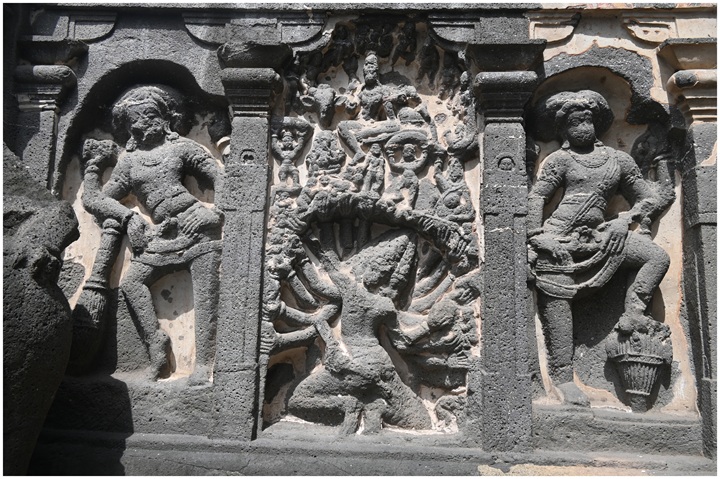 Iconographic Structure of the panel It is readily apparent that at the core of the panel's discussion lies the following observation. • The illustration presented below depicts Ravana, the formidable ten-headed monarch of Lanka, in a posture of kneeling and exerting himself upwards, characterized by his multitude of arms, though it is worth noting that his heads might appear weathered or stylized in their representation. • His posture dramatically conveys the immense strain of someone endeavoring to lift the formidable Mount Kailasa. • Partially eroded though it may be, the artwork positioned above the figure suggests Shiva in attendance with Parvati, embodying a tranquil divine essence that is impervious to the arrogance displayed by Ravana. This scene precisely encapsulates the pivotal moment where Ravana endeavored to uproot the sacred Mount Kailasa, a daring act that was met with Shiva's swift and decisive response of pressing the mountain down with his toe, thereby subduing him. Flanking Figures (Attendant Guardians) On either side of the prominent central recess, there were notable features: The scene is graced by two dvarapala-like figures, essentially guardian figures, who are striking a distinctive tribhanga posture. They are: Bearing a well-developed musculature and adorned with decorative elements. It is noted that the individuals were in possession of weapons, with the specific types identified as potentially maces or staffs. The scene presented a sharp contrast, with Ravana exhibiting clear signs of agitation, while the other figure embodied a serene and composed presence. These figures emphasize divine order and protection, framing the cosmic event. The Ravana Anugraha murthy sculpture follows a two-tier composition Upper Register (Divine Realm): • The divine couple, Shiva and Parvati, were depicted in a moment of profound calm, with Shiva seated at ease beside Parvati. • The iconography of this deity is often complemented by the figures of Ganesha, Kartikeya, or Nandi, who are frequently depicted in association with it. • The mountain is gently being compressed under the subtle pressure of Shiva's foot. Lower Register (Mortal Realm): • Ravana, who is depicted as possessing numerous heads, ranging from five to ten, and an equivalent number of arms, varying from ten to twenty, is a significant figure. • The image captures the immense power and dedication of the figure as they struggle to raise the sacred mountain known as Kailash. • Through its multifaceted nature, the expression masterfully synthesizes corporeal strain with an elevated state of spiritual ardor. Symbolism: • The tranquility embodied by Shiva signifies his ultimate power and control over the entire universe. • The root of Ravana's significant challenges and difficulties can be understood as stemming from the powerful combination of his ego and his boundless ambition. • The mountain serves as a representation of the cosmic axis, often referred to as the axis mundi in various cultural and religious contexts. • The subjugation of one's ego is accomplished through the application of grace. Regional Artistic Variations • The narrative in Northern India tends to strongly emphasize the eventual downfall and the penalties meted out to Ravana. • The religious landscape of Southern India is increasingly highlighting Ravana's character arc, emphasizing his journey as a devotee who underwent a significant change through the power of bhakti. Conclusion : The Ravana Anugraha Murthy sculpture, which draws inspiration from various regions of India, serves as a powerful reminder of a Bharathiyar poem, “செப்பு மொழி பதினெட்டுடையாள் எனிற் சிந்தனை ஒன்றுடையாள்” “Seppu mozhi pathinettudaiyaal enil sindhanai ondrudaiyaal” While it is true that a degree of minor variation exists across the diverse artistic expressions found in different corners of India, the ancient Puranas establish a unique story that connects all of these artists. |
வீடியோ தொகுப்பு
Video Channel 
நிகழ்வுகள் Events 
சிறப்பிதழ்கள் Special Issues 
புகைப்படத் தொகுப்பு Photo Gallery 
|
| (C) 2004, varalaaru.com. All articles are copyrighted to respective authors. Unauthorized reproduction of any article, image or audio/video contents published here, without the prior approval of the authors or varalaaru.com are strictly prohibited. | ||
